BOOKS AND ARTICLES
Books and articles by Rhiannon Hill - psychotherapist, business counsellor and writer.
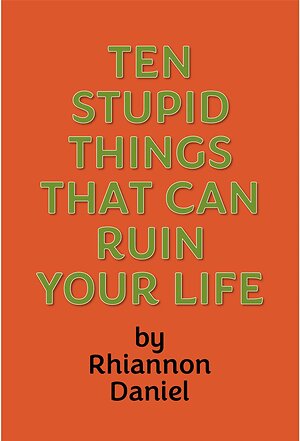
TEN STUPID THINGS THAT CAN RUIN YOUR LIFE. Find It On Amazon Kindle
Everyone could potentially use therapy at some point in their lives, and here's a book that tells you about some of the main issues people address in therapy and describes some of the benefits of working on resolving them. Other people who might need this book are those who have already made a decision to get into therapy but are a bit concerned about what might happen.
Feel like you don't fit somehow? Not comfortable in your own skin perhaps? Relationships always difficult? Worried about dying? Stressing out all the time?
If you have ever thought of getting into therapy and exploring some issues but were too afraid to ask what might happen, this is the book for you!
It's not a book full of difficult jargon, analytical waffle or practical advice.
It's a down to earth, often humorous but insightful guide to the main things that bring people into therapy, with some helpful exercises you can do yourself to get you started.
TEN STUPID THINGS THAT CAN RUIN YOUR WORKING LIFE
Being bullied at work? Trying to run a small company and suspect people are sabotaging or manipulating you? Suspect a work colleague has mental health problems?
This is the book for you!
A look at the things people do at work to mess YOU up and how to identify them, understand them, cope or when to take action.
If you're not sure if therapy is for you, and want to know what’s likely to happen, how to find a good therapist and what sort of issues can be addressed this book can help.
It outlines all the major issues which people bring into therapy. It’s easy to read with exercises and examples to get you started. It is not a self help book, but a primer.
What People Say About the Book:
'I wanted to thank you for your Ten Stupid Things… I have loved the reading and the quizzes, I remember some of them very specifically, number 5 for instance, made me realise I am quite adult and have good common sense.
In number 4 your sense of humour was great when you were describing your attitude towards relationships. The one about Stress was also very good, but painful when you say that stress doesn’t really exist and it is down to us how we deal with it. The last one about death, it was a great choice for the end…………'
'Thanks for the 10 Stupids. I don't know if you believe in synchronicity but it plopped into my inbox just as my wife, arrived home from visiting her dad who is is suffering badly from cancer and she is suffering just as badly. She really needs to talk to him about the fact that he's going to die but she can't bring herself to raise the subject. Neither can anyone else. So, the stuff in your Tenth Stupid was spot on and very timely………'
LOVED your 10 Stupid Things and have really been going over the Addiction one since this has been a recurring theme in my life ……………'
Just dropping you a note to say thanks for the 'ten stupid things' as it has helped me think about my own situation…………'
Utterly brilliant, 12 years into my relationship and this all resonates - it would alot easier if you knew much of this before the whole thing started - I am printing out your notes for my husband and we will discuss them together, I think they'll really help us with this journey we are on…………'
I've looked at your book and I think it's excellent. I'd really like to give it to all new clients that have never been in therapy before. It provides a lovely, straightforward guide as to what kind of things can be worked on in the session - that is particularly for people who interested, not just in solving a particular problem, but who are more into personal growth.
PROBLEMS AT WORK?
Why not get a copy of my second book:
Ten Stupid Things That Can Mess Up Your Working Life by Rhiannon Hill. It's not on Kindle yet, but you can email me for a copy once payment has been made. Please put the correct title in the email subject box so I can send you the right book.
Just £4.99 to visitors to my website. PDF download. Email me for details.
This book is based on a range of experiences myself, colleagues and clients have encountered both as employees and managers, and from using group process to troubleshoot issues in business and organizations.
What people said about Ten Stupid – Work
I have to admit that at first I found this book quite challenging, because I realized that while I had been having problems myself with other people treating me badly at work, I’d also been guilty of doing stuff to other people in the past…thanks for helping me get clear, I don’t feel so alone with the bullying now…………'
I didn’t realize how much of what people think is just messing about and teasing is serious at work. It’s made me open my eyes and I don’t let people get to me so easily now…………'
Thanks so much for this – it’s about time someone gave some tips and support to people who are miserable in the office. Scary but easy to read and even funny sometimes, I read it from cover to cover....'
__________________________________________________________________________________________
BRIEF ENCOUNTERS...
I'm not one for watching movies over and over, but Brief Encounter qualifies.
People are often emotionally overwhelmed and derailed by an unexpected infatuation.
Why does this happen?
Well, some of the reasons include poor emotional intimacy, resentments that have not been processed, making a mis-match that cannot work, being unable to resolve fundamental conflicts. Feeling emotionally disconnected from the one person who is supposed to be your main support system leaves many of us starving for real connection and affection, and making us, therefore, vulnerable to falling in love when we're already in a relationship.
The infatuation often very quickly leads to sexual attraction.
My sense is that most people do want sexual fidelity from the other person, incredibly people still want this from their partner even when they have not been able to be loyal themselves.
But many people believe sexual attraction is an indicator that a relationship should be followed. This isn't always true. Sexual attraction comes up all the time between people, it's natural, but we've forgotten that there's no need to act on it.
If you don't, it frequently wears off.
Of course, there are many settled and enduring second or third relationships that began with an affair. Sadly, some people, had inappropriate role modelling as children and adolescents, so simply don't see the need for fidelity.
One deeper reason for having a series of annoying infatuations on other people when you thought you were in a committed, long term relationship, is sometimes to do with a deep need to be able to attract someone who is emotionally available.
Lots of people of both genders and all sexual orientations have childhood wounds, where a parent or carer, while they may have been able to sustain practical caretaking, were simply emotionally unavailable. Their attention was simply elsewhere. The person grew into an adult who is constantly seeking that closeness, that validation, that attention. If they cannot make a bond in an adult relationship that meets that need, they are vulnerable.
A gesture of kindness, a deeper connection, a better communication, a greater quality of attention is irresistable.
A friend told me many years ago that she fell completely in love with a man who simply put his coat around her shoulders because the heating had broken down in a room where they were on a course!
Taking someone for granted...work commitments...competition with children.....simply forgetting to dialogue about important events, feelings, challenges....these can leave a person with this kind of need extremely vulnerable to the gesture of a stranger.
In Brief Encounter, Fred was caring and solid, but he had settled into a middle aged routine. There was little excitement. Laura tried to inject some interest into their marriage - symbolised by the extravagant birthday gift which excited her to purchase and give. Fred was more interested in the crossword than talking to her. While she knew on one level she was loved and wanted, there was no demonstration.
When glamorous Doctor Alec removed the grit from her eye, she was overwhelmed. This small act may not have registered consciously straight away – Coward’s script includes her narrative in which she says she did not think about it, but the act registered with her unconscious.
Of course, the glory of the movie is the inevitability of doom in that relationship because in those days, people had affairs, but they rarely divorced but while things have changed legally and socially now, most people still say they want a long term, monogamous relationship. As a couple therapist, I would never recommend maintaining a relationship where the corrosion is so great that it would be too hard to reinstate it.
But people often give up easily - I've done so myself in the past.
But the film certainly still stands, in terms of the honesty and brilliantly observed process of the forbidden mutual infatuation. The genius of Noel Coward and the principal actors stands nearly seventy years after it was made. It must have been stunning at the time since it dealt with a subject with mindblowing insight and is still a cult movie now.
While our culture is very different now in many ways, some things have not changed. The process of how an affair starts, develops and progresses in terms of emotional responses is still the same. And the reasons why affairs start are also often the same.
Laura and Alec had to part because of social pressures not to divorce and ‘moral’ standards set in those days.
Nowadays these attitudes are pretty much non existent, but the happiness of children, and the devastation when you lose a long investment in a relationship are still real.
I come from the let it all hang out 1960s, but as I've gone through my life and worked for many years with clients who have found themselves in this position I have changed my views about commitment and fidelity.
This film, if anything, reminds us of our need for those two things, even if social mores have changed and for some, 'serial relationship' seems to be the norm.
__________________________________________________________________________________________
HOW WE GET OUR NEEDS MET - WHAT'S REAL AND WHAT'S YOUR 'STUFF'
One of the major issues that brings people into therapy is the question of how we get our needs met.
There is a range of strategies that human beings develop in order not just to survive but to derive satisfaction in many areas of life.
One of the interesting strategic responses many people come up with is Self Reliance.
Self Reliance is often a compensatory response to feelings as a child that people can't be there for you. This is the result of neglect in many ways. Lots of us were fed, clothed, housed, educated and entertained but our emotional development was neglected. For others, there were material privations. And so on. Some of us decided when we were quite young that no one could really be relied upon to help or support us so we were just going to have to do it ourselves.
I guess this works up to a point.
But this strategy often breaks down when the support required simply cannot be sourced from oneself. Not to say that a level of self support isn't part of becoming an authentic adult, but there is a spectrum of ability to get support appropriately along which we all live.
The spectrum consists of ten broad strata, I'll list them.
1. There is no support for me in the World, ever.
2. I'm sure there is support but I can't rely on it.
3. I'm sure there is support but I don't know how to get it.
4. I can get support, but I don't deserve it.
5. I deserve support but it's very limited so I won't ask
6. I can ask for support and recieve it but it doesn't really help, I can't accept it
7. I can ask for support and receive it but it doesn't last, it's not consistent
8. I can get regular support but it's never enough.
9. I can get enough support and it does help but I feel ashamed that I have to accept it from others
10. I know what I need, how to get it, how much is reasonable, it does help me, I feel ok about it, and it works.
When I was training as a therapist I realised after some sessions we did, that I was quite bad at assessing how much support I needed and deserved, and almost never asked for it! I decided to ring a close friend who I knew was good at giving support. I told him I had support issues and that there was something I really needed right now, and that I had decided to ask him as an experiment, to see what would come up for me in the process. He readily agreed to help me, but I felt absolutely awful! I also learned that I did not have to necessarily 'give back' to everyone that helped me. This was REALLY hard, but I learned the philosophy of Pay It Forward. Google it....and there's a great film about it starring Kevin Spacey.
Now, I feel I know what I need, how to get it, who to get it from, what is reasonable, that I do deserve support, that there's no shame in needing help, and life is a whole lot easier.
__________________________________________________________________________________________
Are You In Love With A Narcissist?
The story of Narcissus is a famous Greek myth about looking into still water, seeing your image and just falling in love with yourself.
But narcissism as a clinical condition at its most serious, and as a growing tendency in our self absorbed society, is no myth.
Clinical narcissism is clearly defined in the Diagnostic Manual for therapists (DSMs 1-V) as a serious mental health issue.
But it’s not as obvious or easy to spot as schizophrenia or paranoia.
I need to emphasise here that many people suffer horribly from these kinds of issues and that in some cases there is a complex diagnosis of more than one ‘label’ condition.
But this article is intended to give a guideline as to what to expect if you do fall in love with someone who is too far along the spectrum of narcissism to be able to relate to you in a healthy and positive way.
The bullet points for determining narcissist behaviours are as follows:
•
At first, lots of charm, these people often value looks, image too highly
•
Lots of bragging and self promotion
•
Acting as if ‘entitled’.
•
Very self focused
•
You may feel you are just not very important
•
You will often feel undermined
•
You may feel your own self esteem begin to diminish
•
Lots of minimising YOUR achievements and skills
•
Lots of demand upon you to do the spade work in the other person’s ‘projects’
•
Often the ambition to deliver a creative project will not be matched by actual skills
•
Ignoring, denying or belittling your concerns about they way you are treated
•
No real empathy for your problems
•
Inability to receive any feedback, enraged when criticised
•
Person is never wrong but you almost always are
You may face accusations which are groundless. The narcissist needs to undermine and reduce you in order to boost their own self worth.
In my experience, narcissists tend to fall into a couple of broad causal groups. Some people have been made the ‘golden child’ in their family, and go into the World assuming others will see them in the same way. They often have talents but don’t bother to develop them in an adult way, so face a lot of disappointment and rejection in the adult world when they don’t measure up.
The other kind of narcissist also has programming from childhood which does make them hardworking, so they do acquire skills and can be quite successful. These people however also think they are very special and superior and will go to enormous lengths to validate this view.
The narcissist often believes that they are superior to everyone else in the World, but that their brilliance goes tragically unrecognised and has to remain a painful secret.
If you are in a relationship with someone like this you may face exhausting demands to support their grandiose plans, and after the project is completed your part in it will be denied or minimised.
The problem with clinical disorders is often that somewhere in the psyche the sufferer has an idea that all is not ok, but this is terrifying so they will redouble their efforts to prove themselves.
If you are in a relationship with a narcissist, your role will be either as an object, if you are nice looking and successful they will need to bask in your reflected glory for a while, in public, but they will also need to dismantle your abilities and assets in private.
You will not be supported and cared for when you have needs because these will get in the way of the project. Many narcissists don’t see others as important or deserving of empathy and support.
Unfortunately, narcissists do not do well in therapy, because this would involve being honest, admitting how they are behaving badly towards others, and revealing their vulnerabilities, specifically shortcomings and imperfections.
If you are in a relationship with a narcissist, especially if they are suffering at clinical level, my view is that they are very unlikely to grow and change, not just because of the terror of being found out, but because being a narcissist means that you think you are special and superior and they tend to project that on to the therapist, thus rendering a genuine therapeutic contract from being created.